
Find Out Who Owns a Fountain County Parcel
Two county records settle the question in sequence. Engage/XSoft takes an owner name, an address, or a property number and returns a parcel card with a "Deeded Owner" row. Read that row exactly. The Fountain Recorder index then tests the roll name against the most recent recorded conveyance.
- Enter at least three address characters in Engage and choose the correct situs.
- Copy the Deeded Owner, APN, map number, tax district, and legal-description text.
- Search the owner as grantee in Doxpop and compare the latest deed's parties, date, and description.
- For an LLC, verify the entity spelling in INBiz, without treating its agent as the landowner.
This method names the party the official property records tie to the tract. It does not promise instant results for a just-closed sale. Fountain County posts a current-data notice but publishes no fixed roll-refresh interval, so note the date you viewed the portal alongside your conclusion.
Choose the Right Fountain County Ownership Source
Each source answers one narrow question. Used together, they keep a quick administrative display from being mistaken for recorded title evidence in Fountain County.
| Source | Owner Info It Gives | Access |
|---|---|---|
| Engage assessment roll | Deeded Owner, situs, mailing data, APN | Current-data notice; may lag a new deed |
| Doxpop Recorder index | Grantor, grantee, recording and description clues | Index from June 1992; scans from January 2003 |
| Engage map result | Selected parcel tied to Summary and record tabs | Useful identity view, not a survey |
| INBiz | Official entity spelling, status, agent and address | Business context, not proof of parcel ownership |
None of these sources identifies an occupant from a situs address alone. An owner may receive mail somewhere else entirely, and an entity can hold Fountain County land without operating from it.
Read the Exact “Deeded Owner” Row
A Fountain County parcel card can display current and history owner rows. Those sit beside the property address, parcel and map numbers, acreage, legal description, district, and parties. Copy the identity fields together. One South Kingman Road parcel, for example, lists an LLC as deeded owner. That owner carries a mailing address in another area. That is exactly why a mailing line can never be relabeled as the property's location. The selected Engage record shows the parcel interface and its fields.
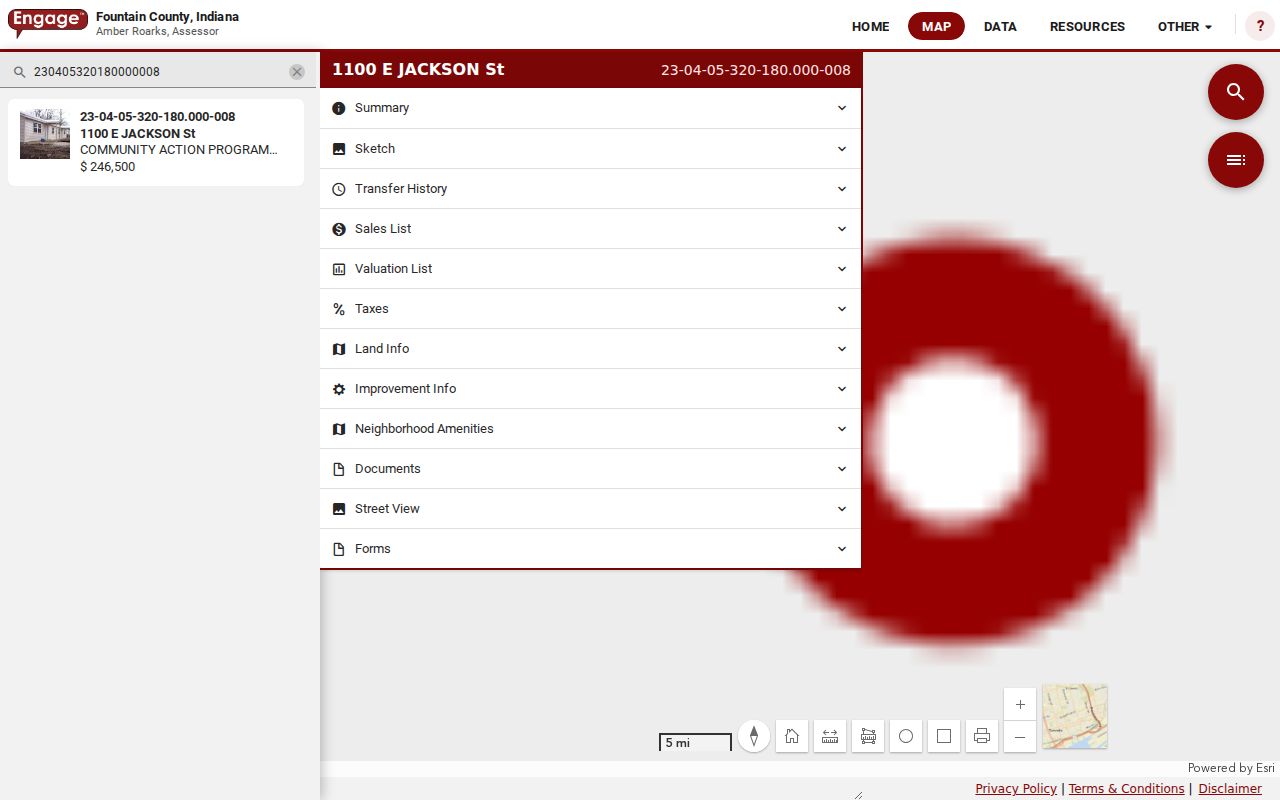
Copy every identity field together so a common owner name never attaches to the wrong Fountain County tract.
- Owner of record
- The party currently carried on the public administrative roll.
- Grantee
- The party receiving the recorded interest.
- Situs
- The parcel location, distinct from the owner's mailing address.
- Title
- The legal ownership interest, which a search result alone does not adjudicate.
Trace the Assessor Name to the Latest Deed
Doxpop searches by party name, document number, or book and page. Enter the tax-roll owner as grantee and pick out the most recent plausible instrument. Then compare its legal description with the parcel. According to Doxpop's partner table, the Fountain County index reaches back to June 1992. Scanned images run from January 2003. Anything older means the Recorder, deed books, or State Library microfilm. Doxpop allows six free searches each month with an account. Other packages and document images carry charges. A purchased PDF stays available for 72 hours. For certified evidence or help past the online cutoff, go to the Recorder's Covington counter. Don't stop at an index line.
Note: A Recorder index identifies a filing; read the instrument before relying on its abbreviated party or description fields.
Identify LLC, Trust, and Estate Ownership
Search business and fiduciary names exactly as the Fountain County parcel card presents them. Try punctuation or abbreviated variants if the first attempt fails. INBiz can resolve the formal identity behind an LLC. A trust or estate may require the deed. It may also require a public probate docket in Indiana MyCase. Probate, executor deeds, foreclosure, partition, or quiet-title proceedings often explain a transfer outside an ordinary sale. A registered agent is a business contact. The agent is not automatically the beneficial owner, grantee, or occupant of the parcel. The same caution applies to estates. A representative's name never erases the estate or fiduciary capacity printed on the instrument.
Resolve a Recent Sale or Changed APN
Fountain County published current-data dates in late August and September 2026. But the county sets no fixed deed-to-roll interval. When names conflict, compare dates before calling either portal wrong. The deed may lead the roll. A split or combine may have moved the land into a successor APN. One sample tax record shows a quitclaim entry under Tax ID 001-08405-00. It also shows owner-mailing changes and split/combine notes. Keep both old and new identifiers. Then ask the Fountain County Assessor at 301 4th Street, Covington, 765-793-6206 to clarify an administrative transition.
Use Five Records Before Relying on the Name
For consequential due diligence, compare five records before trusting any single name. Check the Engage parcel identity first. Add the tax-roll owner and mailing fields for billing context. Pull the newest Recorder instrument, the relevant court or probate docket, and any recorded plat. The parcel number is the bridge among current systems. The legal description is the stronger bridge across deeds and changed parcel numbers. A needed existing record may not be online. Contact the custodian by phone, mail, or in person. Indiana's Access to Public Records Act, Indiana Code 5-14-3, backs a request. It covers an identifiable existing record. It does not generally force an office to build a custom ownership analysis. The five sources also cure different kinds of doubt. Engage supplies the current administrative identity. A recorded deed shows the named parties, recording date, and legal description. MyCase can reveal a probate, foreclosure, quiet-title, or partition matter behind an unusual Fountain County transfer. A plat matches a lot to its recorded subdivision. Agreement across those records beats one name echoed through copied databases.
Know What a Fountain Ownership Lookup Cannot Prove
A Fountain County roll name proves none of these. It does not prove occupancy, every unrecorded interest, lien priority, boundary location, or marketable title. A GIS polygon is not a survey. A mailing address is not the situs. A business filing adds entity context. It never establishes who holds a beneficial interest in the real estate. Keep the access date with each ownership conclusion you write down. Indiana's Address Confidentiality Program may limit what an office displays. The covered-person restriction under Indiana Code 36-1-8.5 may limit it as well. Never try to bypass a protected record. Use the dedicated current-owner page for roll timing. Use the former-owner page for the backward chain of Fountain County deed records.
Not a title search. Owner data can guide legitimate property research, but the newest deed and complete title evidence require verification with the proper custodian.
Recover a Fountain County Owner Search With No Result
A failed address lookup does not mean the parcel has no owner of record. Engage starts suggesting matches after three characters, so shorten what you typed and pick the matching situs from the list. Then try the property number from a tax bill, deed, survey, or plat. Auditor and Treasurer instructions also let you search by parcel number, owner name, or property address with city. They caution that too many filled fields can choke the results, so open with one telling field rather than every box.
Search the surname alone when a name stalls. Then try the full indexed spelling. Keep ampersands, initials, company suffixes, trustee language, and estate capacity as separate variants. A history row can carry a company name even when the deed search used an individual. INBiz helps confirm the correct entity spelling, though its registered-agent and governing-person fields are business context only. They do not prove those individuals own the parcel.
Street addresses also fail after a split, a combine, rural renumbering, or a parcel change. One Fountain sample shows a quitclaim, Tax ID, mailing changes, and split and combine notes on a single card. Trace the old identifier forward through the legal description. When a card says See Legal Description, pull the instrument or plat, because abbreviated section-township-range text may describe only part of the land.
If the online route dead-ends, call the Assessor at 765-793-6206 or visit 301 4th Street in Covington with the situs, possible owner, APN or old APN, and map number. Ask the Recorder for an index check, a certified copy, or older book access. Counter service, telephone, mail, State Library microfilm, and local library research all work without the web. A tight request for an existing record beats asking an office to settle who owns a vague patch of ground.
Older ownership questions reach past Doxpop. The State Library's Fountain guide and microfilm inventory carry general indexes from 1826 and deed runs from 1827. The 1865 and 1897 owner maps can suggest a historic name. Probate, will, estate, and partition holdings explain transfers outside an ordinary sale. For who owns the parcel today, though, the present tax roll and the newest deed still govern.
Note: Record every spelling and parcel-identity change so the owner conclusion can be retraced to the exact official result.