
Trace Back Fountain County's Former Owners
Build a timeline of transfers, not just a list of names. Doxpop's partner table places the verified online Fountain index start at June 1992 and the image start at January 2003. For anything older, the State Library microfilm guide lays out the deed and index route through microfilm.
| Source | Years It Covers | Where Held | What It Shows |
|---|---|---|---|
| Doxpop Recorder index | June 1992 forward | Online partner search | Party, document number, book/page |
| Scanned Recorder images | January 2003 forward | Doxpop purchase or Recorder | Instrument text and description |
| Deed books and general indexes | 1826–1887 verified runs | Recorder and State Library microfilm | Earlier grantor-grantee links |
| Owner maps and plats | 1865, 1897 and later editions | Indiana State Library | Owner snapshots, roads, and town lots |
Start online for a modern chain of title. When you hit the coverage cutoff, switch tools rather than assuming no older deed exists. The county documents no catastrophic records loss. The real limit is online coverage and the scope of finding aids, not a courthouse fire.
Walk the Fountain County Deed Chain Backward
Anchor the land first. Pull the current parcel number and legal description from Engage, then step through the transfers with Doxpop's party-name, document-number, or book/page search to work the deed chain backward.
- Find the current owner's acquisition with that party listed as grantee.
- Read the grantor, deed type, recording date, document or book/page, and legal description.
- Search that grantor as a grantee to locate how the prior owner acquired the same land.
- Repeat to June 1992, then continue through the general index and deed books.
- Grantor / grantee
- The conveying party and receiving party named in an instrument.
- Chain of title
- The ordered sequence of recorded ownership links for the same land.
- Reverse index
- The grantee-side route used to locate a person's acquisition.
- Warranty / quitclaim deed
- Different conveyance forms whose legal effect must be read in the instrument.
Mark the 1992 and 2003 Online Thresholds
The recorder coverage page visibly reports Fountain County's index and image dates.
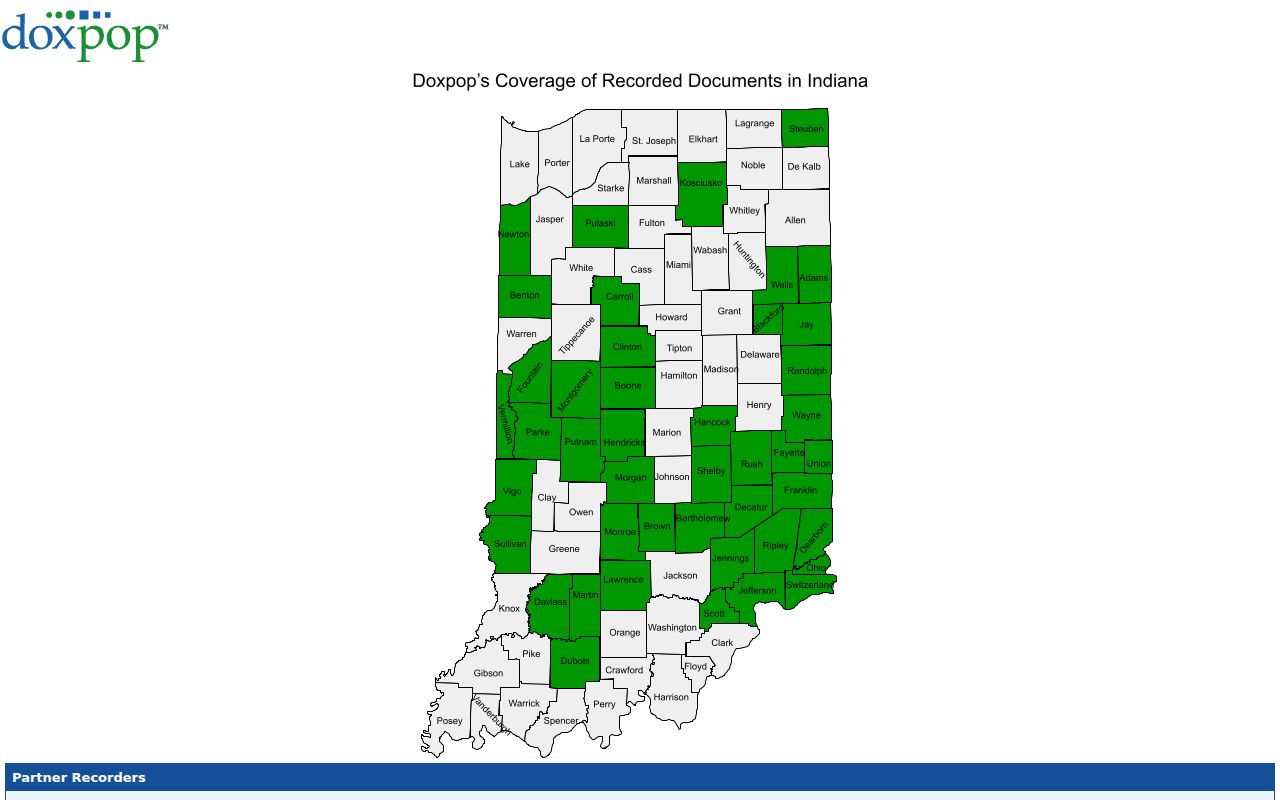
The two dates answer different questions. A deed can sit in the online index from 1992 forward even though the scanned image series only begins in 2003, so an indexed record may still need a courthouse copy.
Go Back Through the 1826–1887 Books
The State Library finding aid lists general index Volumes 1–3. These span 1826–1853. Deed-volume runs begin in 1827. Historic books are organized by people, dates, legal descriptions, and book/page. They do not use a modern parcel number. When a volume run looks irregular or overlapping, search adjacent volumes and the general index too.
One microfilm entry skips from Volume 6 to Volume 8 across 1836–1839. That is an indexing anomaly in the finding aid. It is not proof that a deed book burned or vanished. Ask the Recorder or the State Library to check neighboring volumes and reel identifiers before you call it a gap.
Note: Online Recorder coverage begins in June 1992; earlier former owners require county books, microfilm, or archive and library access.
Bridge Probate and Partition Transfers
Not every transfer was an ordinary sale. A former-owner chain may pass through an executor deed, estate order, guardianship, partition, or quiet-title matter instead. Fountain County's historical holdings include probate order books from 1826–1920, probate files from 1827–1920, wills from 1827–1923, and estates from 1832–1900. Partitions run from 1856–1923.
For a modern case, search Indiana MyCase when the matter is public, then request older or fuller material from the Fountain County Clerk. Carry the decedent, representative, heirs, sale buyer, dates, and parcel description back into the Recorder index. A probate name explains a break in the chain. Only the linked land record proves which parcel followed.
Pair Old Owner Maps With Recorded Deeds
The State Library map catalog lists an 1865 property-owner map plus an 1897 map with owners and plats for Attica, Covington, and Veedersburg. Later plat books run through 2015.
A map gives a dated snapshot of ownership, never a complete chain. Use it to spot a candidate name or an old road. Then verify that person in the matching general index and deed volume. For Veedersburg research before December 1893, also try the historic "Veedersburgh" spelling.
Reconcile Names and Legal Descriptions
Search surnames, initials, companies, trustees, and estates in the exact forms the record prints. A changed marital name or stray punctuation in an entity name can hide a link. When no address existed yet, the parcel number changed later, and the record looks disconnected, the legal description is the continuity check.
Fountain County records lean on dense shorthand like FR PT E 1/2 NW 13-18-8 .034A. Some entries show a "See Legal Description" prompt instead. Never treat that summary as the full boundary. Compare the instrument, plat, section-township-range references, and book/page. Only then add a prior owner of record to your timeline.
Know How Far Back Fountain Ownership Records Reach
Fountain County land records reach into the county's first years after organization in 1825–1826. Deed and general-index runs cover 1826–1887. That coverage does not guarantee every tract traces cleanly to an original patent. Check the applicable index. Check adjacent book runs, the description, and any probate or partition bridge. Only then stop.
For archive access, use the State Library finding aid. Supply call number, title, and size when requesting maps. The Covington-Veedersburg Public Library offers genealogy help, copying, public computers, interlibrary loan, and Ancestry access. Its local-history contact is genealogy@cvlibrary.in.gov. Ask staff which city-directory years it holds rather than assuming a range.
A practical archive request starts with evidence from the newest record. Give staff the current legal description. Include the last confirmed grantee, the older grantor being traced, and the known book or year range. The State Library inventory lists general indexes alongside deed volumes, which matters when a direct volume search fails. Its L-4 run skips from Volume 6 to Volume 8 across part of 1836–1839. That is a finding-aid anomaly, not proof of destroyed records. Search adjacent volumes and the general index before declaring a gap.
Historic maps add a second check. The 1865 and 1897 owner maps can place a surname on a tract. The 1897 sheet includes plats for Attica, Covington, and Veedersburg. Map labels are leads, not conveyances. Return to the deed book for parties, date, and description. Reach for probate order books, wills, estates, or partition files whenever ownership passed outside an ordinary sale.
Verify every link. Use former-owner records for land history, estate work, and purchase diligence. Do not infer a living person's location or use the chain to harass anyone.
Build a Verifiable Fountain County Ownership Timeline
A strong former-owner log gives each transfer its own row. Record the date, grantor, and grantee. Note the deed type, instrument or book/page, a legal-description match, and when you accessed the source. Note changes separately. Track a surname shift, trust capacity, an estate representative, a split, a combine, or a parcel-number transition. Fountain County deed records rarely line up neatly. Keeping those facts distinct stops a map label, a tax-roll name, and a recorded grantee from collapsing into one unsupported ownership claim.
Doxpop's party search wants the format Last Name, First Name. Document-number and book/page modes offer other routes when names drift. Search every conveyance in both directions. The grantee side surfaces an acquisition; the grantor side confirms a later disposition. For company owners, check the deed spelling against INBiz. Business status or registered-agent details can explain a variant. Do not add those individuals to the land chain. Deed form matters, too. A Fountain County parcel can carry deeds, mortgages, releases, assignments, partitions, plats, cemetery deeds, quiet-title documents, and liens. A mortgage rarely means a new fee owner. A release clears an obligation rather than conveying the parcel. A plat organizes lots without proving every later transfer. Record why each document belongs in the timeline.
At the online limit, convert the last reliable party, date, description, and book/page into an archive request. The State Library finding aid lists deed-volume and general-index runs with reel references. Covington-Veedersburg Public Library handles copying, interlibrary loan, computers, Ancestry access, and genealogy help at genealogy@cvlibrary.in.gov. Staff can dig up newspapers, obituaries, histories, or cemetery material that clarify identities. Treat those as supporting evidence, not the deed chain itself.
Historic owner maps work best as checkpoints. If the 1897 map puts a surname on the expected tract, search that person in surrounding index years and find the deed volume. If map and deed disagree, test a neighboring tract, an alternate spelling, or a partition instead of forcing the label into the chain. Around Veedersburg, remember that Veedersburgh was a documented spelling before December 1893.
A finished Fountain County ownership timeline should state its stopping point. Say plainly whether the chain ends at the June 1992 web threshold, a specific book or index entry, or an unresolved probate or description problem. County property records reach back to the earliest decades. Old books do not promise that every modern parcel traces cleanly in one session.