
Fountain County Value Types
A parcel card carries several numbers that answer different questions. Indiana assesses real property at 100 percent of market value-in-use. That is a statutory concept tied to how the property is used. It does not make the assessed figure identical to a sale price. The Engage record also splits land from improvements. That helps explain which part changed between years.
| Value type | Meaning | Official record |
|---|---|---|
| Assessed value | The market-value-in-use figure placed on the assessment roll | Assessor's Engage valuation record |
| Market value | A probable exchange value under stated conditions, which may require a current appraisal | Not established by the tax roll alone |
| Sale or consideration price | The amount tied to a processed transfer, subject to disclosure and sale circumstances | Engage Sales List, sales disclosure, or recorded deed trail |
| Land and improvements | The assessment split between the site and structures | Parcel card valuation fields |
The assessment ratio is 100 percent, yet value and price can still differ. A sale reflects one deal on one date. Assessment applies Indiana's valuation rules across the whole tax roll. Financing terms, related parties, and unusual property condition can all make a sale a weak comparison for a parcel's assessed value. Timing can weaken it too.
Read Fountain Valuation Fields
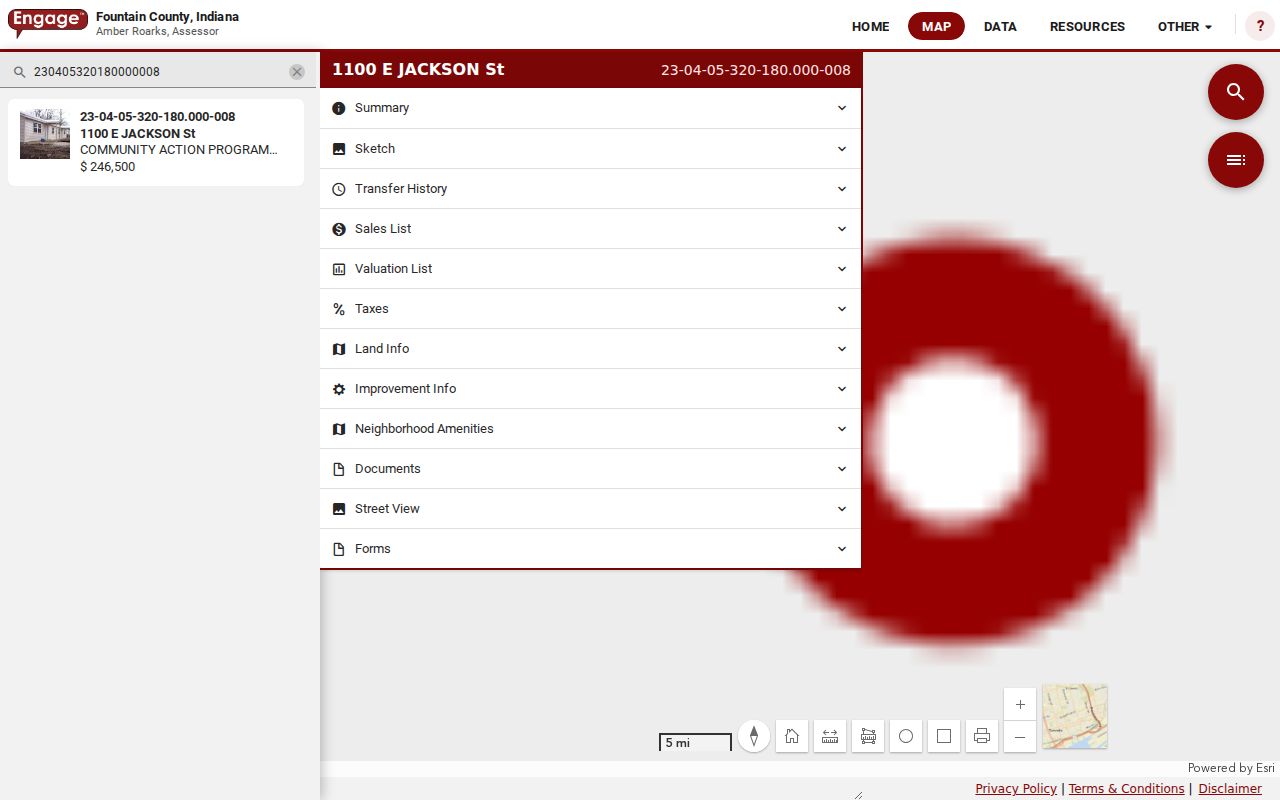
The Fountain County Engage result opens into several tabs. They cover Valuation List, Sales List, Land, Sketch, Transfer History, Taxes, and Forms. For a value question, stay with Valuation List, Land, Sketch, and Sales List. The tax tab answers a different question about charges. Check the assessment year before comparing figures. Then confirm the situs, APN, acreage, and legal description identify the intended parcel. The official selected-parcel view shows how the tabs stay linked to one record. It is a useful visual check before copying a number.
Fountain's Full Assessment Ratio
Indiana's level of assessment is 100 percent. In plain terms, the assessed value aims at market value-in-use rather than a fraction of it. That phrase asks what the property is worth for its current use under Indiana's assessment system. It is not simply the most recent purchase amount. The Indiana Department of Local Government Finance publishes the statewide overview along with Fountain County ratio studies, approval letters, and land-order material. Those sources explain the framework behind the roll. A ratio study tests assessment performance across groups of sales. It does not replace an individual parcel review.
Fountain Land and Improvements
Separate land and improvement amounts can reveal why the total moved. A land-order update can shift the site component. New construction, demolition, remodeling, or corrected characteristics may affect improvements. The Sketch and parcel data help test whether the record describes the actual buildings. A very short legal description or fractional tract can also signal the need for care. One card uses abbreviated section-township-range language and points to the full legal description. Do not compare the value to a nearby town lot until acreage, use, and parcel boundaries are truly comparable.
Compare Fountain County Sales
Engage's Sales List and sales-disclosure resources provide the processed-sale layer. The portal guidance warns that sales may be absent in some cases. They may be older, exempt, or not yet processed. A missing row does not prove that no transfer occurred. Search the Recorder index when a deed is expected, and check the parcel's Transfer History. Indiana's revised State Form 46021 is required when a conveyance is filed in 2026. The Auditor may reject a missing, incomplete, or unstamped form. Separate forms generally apply to separate parcels. An exception exists when contiguous parcels share a taxing district. That makes parcel identity vital when comparing consideration across a multi-parcel deal.
Fountain Values Change Annually
Indiana uses annual trending and a four-year cyclical reassessment. The current statewide cycle runs from 2026 through 2030. At least one quarter of parcels are reviewed each year. A visible value change may therefore come from market evidence or physical review. It may also come from new data or a corrected record rather than a sale. Always compare like years. A pay-year tax page, an assessment-year value, and a deed date are different time labels. Valuation meaning is where the parcel record stops. The tax record determines how assessed amounts, deductions, credits, rates, and charges combine on a bill.
Estimate Fountain County Property Value
Begin with the address, but switch to the APN as soon as it appears. Fountain County examples use both a hyphenated parcel number and a map code. Copying the exact identifier prevents a split, combination, or similar street address from sending the property search to the wrong record.
- Search the address or property number in Fountain County Engage/XSoft.
- Confirm the situs, APN, legal-description clues, acreage, and assessment year.
- Read the land, improvement, and total amounts in Valuation List.
- Open Sales List and Transfer History for processed transaction context.
- Compare suitable sales and obtain an appraisal when a current opinion is needed.
- Assessed value
- The value carried on the official assessment roll.
- Market value-in-use
- Indiana's standard for the value of property in its current use.
- Assessment ratio
- The relationship between assessed and market value; Indiana uses 100 percent.
- Reassessment
- The scheduled review of property data and value within the statewide cycle.
Rates Do Not Rank Values
The pay-2026 totals for Attica district 008, Covington district 016, and Veedersburg district 018 are 2.604200, 2.139200, and 1.930200. Those figures are tax rates, not rankings of property value. A lower district rate does not prove that homes or land there carry lower assessed or market values. Keep the measures separate. The assessor supplies value. The taxing district helps calculate a bill. Deductions and credits can change taxable outcomes without changing the underlying assessment in the same way.
Fountain Storm Value Evidence
The official Engage materials describe relief connected to the August 2026 storm and flood emergency. State Form 137R carries an August 10, 2027 filing deadline. Supporting material may include photographs, insurance information, appraisals, and repair estimates. Relief is not guaranteed. The assessor weighs what each document actually shows.
Date Fountain Value Evidence
One Fountain County property value comparison can hide three different dates. There is the assessment year on the parcel card. There is the pay year on the tax record. And there is the recording or transfer date on the deed. Treat them separately. A 2025 assessment may support a later pay-year tax bill. Yet a deed recorded after the assessment date may not show up in the same roll snapshot. Write the date beside every figure. Only then compare land, improvement, total, or sale amounts drawn from Fountain County property records.
Parcel identity needs a date trail too. Fountain examples use a hyphenated number like 23-15-13-105-002.001-020. That number comes with a second tax identifier. A compact map code rounds out the set. A split or combination can replace a tract without erasing older property records. When a current value seems disconnected from a prior sale, check Transfer History first. Then check the tax-card notes, the deed, and any split or combination entry. The recorder and the assessor can each hold a different piece of that trail. So look before assuming the appraisal is wrong.
| Evidence | Date to record | Question it answers |
|---|---|---|
| Valuation List | Assessment year | What amount was placed on the roll? |
| Sales List | Sale and processing dates | Which transfer entered the assessor's sale data? |
| Recorder instrument | Execution and recording dates | What conveyance was placed in the land record? |
| Tax page | Pay year | Which year's rate and charges were applied? |
The Fountain County ratio-study and land-order materials offer wider assessment context. They show how groups of parcels and land classes were reviewed. They do not deliver a private appraisal for one tract. For a property-specific concern, start with the physical facts in Engage: acreage, sketch, land classification, and improvements listed on the parcel record. A wrong input can matter as much as a disputed valuation judgment.
Limits of Fountain Property Value
An assessed value is a mass-appraisal result built for public administration. It does not guarantee a sale amount, define a boundary, or prove clear title. A recorded price may also reflect terms that make it unlike an open-market sale.
Value is not price. A Fountain County assessed value is not what a property must sell for, and the public record is not an appraisal.
Use the tax roll to understand how Fountain County currently assesses the parcel. Treat processed sales as evidence, not a verdict. When a present opinion matters, a qualified appraiser can inspect the property and apply an effective date and stated purpose.