
Fountain County Deed Records and Their Transfer Clues
A recorded deed in Fountain County names the parties, states the instrument type, and gives the execution or recording date along with a book/page or document number and a property description. Read it next to the index rather than trusting the assessor's current owner name to capture every term of the conveyance.
| Deed Type | What It Does | Common Use |
|---|---|---|
| Warranty deed | Conveys the described interest with stated covenants | Ordinary purchase transfer |
| Quitclaim deed | Conveys whatever interest the grantor has | Interest cleanup or related-party transfer |
| Trustee or executor deed | Conveys through a trust or estate representative | Trust administration or probate |
| Sheriff or tax deed | Records a transfer arising from an official process | Foreclosure or tax proceeding |
| Plat or partition | Defines lots or divides property interests | Subdivision and ownership division |
Deeds and their neighbors serve different purposes. A deed conveys an interest. A mortgage, assignment, release, or mechanic's lien, by contrast, deals with an encumbrance and its status. The Recorder keeps both families of records, plus cemetery deeds, quiet-title material, and plat books. Indexing proves an instrument was recorded, not that every claim inside it is legally effective.
Fountain Recorder Coverage Starts in 1992 Online
The Doxpop partner coverage table places Fountain County index data at June 1992. Scanned images start at January 2003. So a 1990s instrument may carry an index entry but no web image. A pre-1992 deed may not appear in the partner index at all. The coverage page displays that date split clearly for anyone planning a property search.
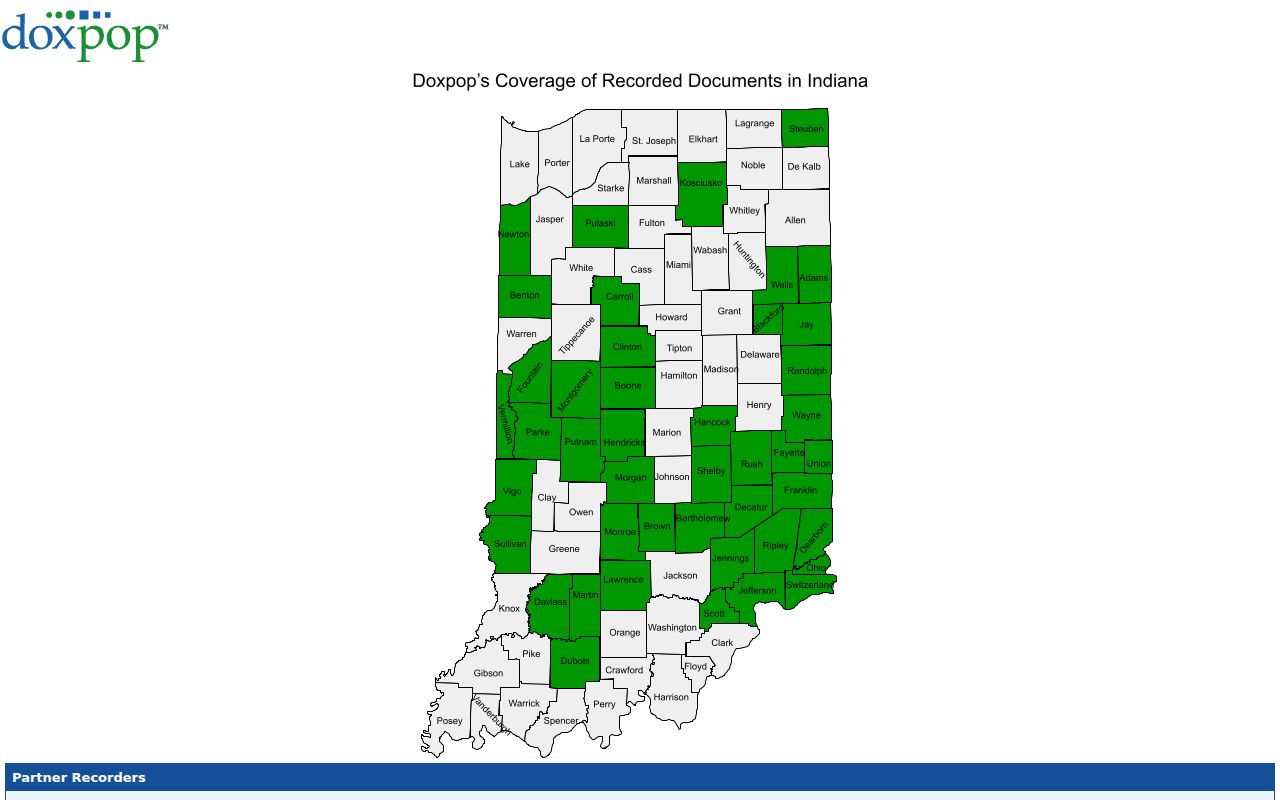
Treat the dates as routing rules. Index online where coverage applies, then turn to deed books, microfilm, or Recorder help instead of reading a null result as no deed. Note: Fountain land records reach back decades before online partner coverage begins.
Search Fountain Deeds by Party, Document, or Book/Page
The Doxpop recorded-document finder offers three basic modes, with party searches using "Last Name, First Name" and separate fields for a document number or book/page.
| Finder mode | Entry | When it helps |
|---|---|---|
| Party Name | Surname and given name, plus entity variants | Build grantor and grantee results |
| Document Number | Known instrument identifier | Retrieve a citation from another record |
| Book/Page | Separate volume and page values | Open a historical cross-reference |
The captured finder shows the access layer used for Fountain County deed records.
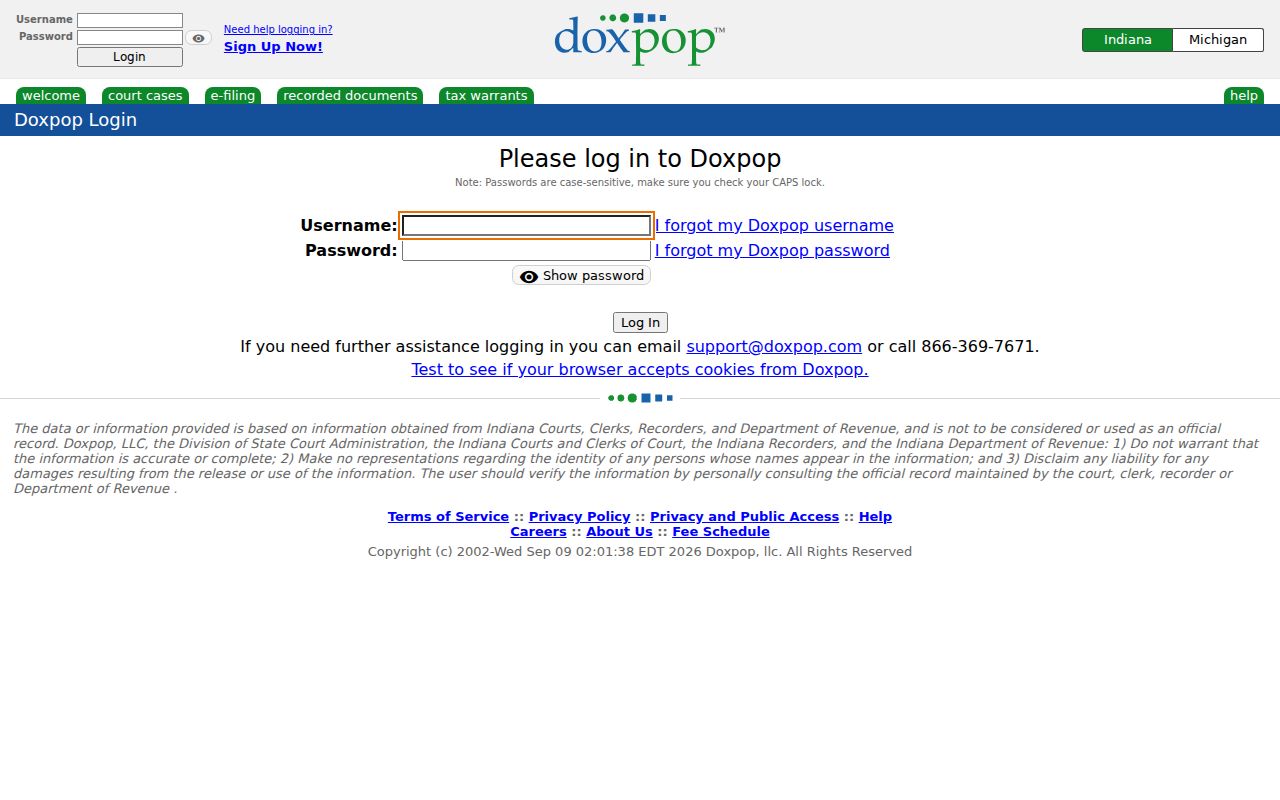
Document-type and date filters do not appear consistently in the interface. Confirm the current options in the live form before relying on them.
Walk the Fountain County Grantor-Grantee Index
Every Fountain County transfer appears twice in the index. The grantor side names the party conveying an interest, and the grantee side names the recipient. Checking both directions separates a purchase from a later disposition and keeps similarly named people and companies from blurring together.
- Find the present roll name in Engage, then search that party as grantee.
- Open the likely acquisition deed and compare legal description, parcel clues, and dates.
- Take its grantor and search that name as a grantee to find the earlier acquisition.
- Repeat, recording every instrument number or book/page and switching to offline volumes before June 1992.
- Grantor
- The party conveying the stated interest.
- Grantee
- The party receiving that interest.
- Chain of title
- The connected sequence of recorded conveyances for the same land.
- Book/Page and Instrument Number
- Two citation systems used to return to a recorded document.
Before 1992, Follow Fountain Deed Books and Microfilm
The Indiana State Library Fountain microfilm inventory lists deed-book and general-index runs reaching back to the 1820s, including overlapping index volumes and a deed-book run covering 1826 to 1887. One quirk: the L-4 reel listing skips from Volume 6 to Volume 8 for 1836 to 1839. That gap reflects the inventory itself, not destroyed records. Work from the general index to find the right book, request the listed reel or physical volume through the State Library call-slip process, and check adjacent books whenever a cited volume is not where expected. The State Library map collection adds an 1865 owner map and an 1897 map showing property owners and city plats. Use those maps as finding aids, not as conveyances.
Recognize Other Instruments Beside Fountain Deeds
Fountain County Recorder books hold far more than deeds. Mortgages, releases, and assignments all share the indexes. So do mechanic's liens, oil and gas leases, and partitions. Plats, cemetery deeds, and quiet-title material appear there as well. A mortgage does not pass ownership the way a deed does. A release is a separate filing that may come long after payoff. Mechanic's-lien guidance points to a 90-day filing window after labor or materials. But indexing alone never establishes validity. Military-discharge records fall under restricted access through Indiana Code 10-17-2-4. Not every recorded family is open through the same web portal.
Doxpop Image Charges Differ From Index Access
The official Doxpop fee page describes a free account with six searches per month plus paid packages. Those packages include $38 for 20 searches and $68 for 60. Recorded images cost $2.10 at the free tier. The price drops to $1.45 at the 20/60 tier and $1.13 above 60 searches. Registered users can preview, but saving or printing requires purchase. The PDF stays available for 72 hours. These are partner charges, not a certified-copy schedule from the county. Ask the Recorder directly for current counter, mail, certification, payment, and delivery details.
Watch New Fountain County Recordings by Name
Doxpop Property Watch is a free service that lets you sign up for alerts by state, county, and full name or legal description. Why not an address or parcel number? Indiana recorded documents do not always include an APN or street address, so the match has to rest on names and legal descriptions instead. Rural section-township-range descriptions can also trigger false positives. A square mile of land can share one description.
Treat any alert as a prompt to pull the instrument itself. It is not proof of fraud. Before acting, read the recorded document and compare party names, legal description, document type, and recording date.
Use Probate and Court Files to Explain Unusual Deeds
Some Fountain County deeds carry official signatures: an executor, personal representative, trustee, or sheriff. Their authority often rests in a separate court record. Search Indiana MyCase and the Fountain County Clerk for probate, foreclosure, partition, or quiet-title proceedings. Then match case parties and order dates to the deed. A court file explains why a transfer happened. But the later recorded instrument still governs. A tax-card note about a tax deed, split, or combine is only a lead. Record the parent and child parcel numbers. Search Recorder entries under both former and new owners. When an estate interrupts an otherwise clean chain, try the decedent's name, the estate caption, the representative, and heirs. Entity variants help too.
Verify Every Fountain Deed Link by Land Description
A shared surname can tie the wrong people together. In Fountain County, the land anchors a chain of title, not the names on it. Compare the legal description at every step. Check the acreage, subdivision or section-township-range language, and book/page references. One Fountain description uses fractional shorthand. A parcel card may read "Lots: See Legal Description." Copy the original text rather than normalizing abbreviations.
A parcel number reconnects deed and assessor card. Yet Indiana recordings often omit the APN or a street address. So the recorded legal description becomes the durable link. It holds for rural land, historic tracts, and any parcel affected by splits or combines.
Pair Historic Owner Maps With Fountain Deed Indexes
The State Library's Fountain County map holdings pair well with deed indexes. Deed indexes help with older land research. When an address search fails, try the 1865 Fountain and Warren property-owner map or the 1897 Standard Map. Either map can supply a surname, road area, town, or plat name instead. The 1897 map shows property owners and plats for Attica, Covington, and Veedersburg. Later holdings add rural-delivery maps. They include the 1914 Attica Ledger-Press map, farm maps, and several Fountain-Warren plat books.
Once a mapped owner or plat name surfaces, search the general deed index. Search for that party during the right period. Follow the book/page citation to the deed volume. There, compare township, range, section, lot, block, acreage, and neighboring owners. Keep in mind that a label on a map is not a deed. It may reflect publication timing rather than an exactly dated transfer.
Fountain Recorder Access Continues Offline
Doxpop sometimes lists an index entry without a scan. Request the cited page at the Recorder counter or through an available copy-request method. Older indexes raise a different problem. An index may predate June 1992. Turn instead to the Recorder's general index, State Library microfilm, county books, and library or archive finding aids. Include every known spelling, the approximate year, the instrument family, and the legal description.
The Covington-Veedersburg Public Library helps too. It offers public computers, copying, interlibrary loan, Ancestry access, and genealogy assistance. Local staff can help identify a finding aid. The Recorder remains custodian of the official land instruments. Keep a research copy distinct from a certified copy meant for formal reliance.
Get a Fountain County Deed Copy
Use Doxpop for a covered index entry or a purchased image. Otherwise, go straight to the Fountain County Recorder. Reach the office through the county directory or visit 301 4th Street, Covington, IN 47932. Direct contact fits deeds that predate image coverage. It also handles certified requests or documents the portal omits. Supply party names plus an instrument number or book/page. Add the approximate recording date and the legal description.
Mail and counter service still matter. Older volumes and certified copies depend on them. The Recorder publishes no official fee schedule online. Confirm copy price, certification costs, and accepted payment directly. Do not apply Doxpop's online-image charge.
Recorded, not guaranteed. Fountain County deed records show indexed instruments, not a title opinion. Unrecorded interests, recording defects, or later court orders may require professional examination.