
How to Search Fountain County Property Records
Start at Engage/XSoft. Type at least three characters. It will match an owner name, street address, or property number. Each result pulls the clues together: the punctured APN, map number, deeded owner, district, and legal description. Tabs dig into detail. It is the fastest way to connect a readable clue to an official parcel number.
One portal is never the whole story. Recorder instruments prove what was actually recorded. Treasurer pages add tax bill context. A GIS map gives orientation rather than survey-grade evidence. Cross-check them.
- Search Engage by address, owner, or parcel.
- Copy the APN, deeded owner, and legal description.
- Search Doxpop for deeds and related instruments.
- Check tax year, installments, balance, and district in the local roll.
- Use GIS and recorded plats for geometry, then request offline or certified records from the custodian.
The Offices Behind Fountain County Property Records
Most counter work happens at 301 4th Street in Covington, Indiana 47932. The Recorder preserves permanent land instruments. The Assessor maintains parcel and value records, while the Treasurer handles bills and payment status.
Start With Address, Owner, or Parcel Number
Each search key has a strength. An address reads easiest. An owner name can surface multiple roll entries. The APN is the precise cross-system key for a current parcel. The local tax search asks for a city with the street. It also warns that too many fields narrow results. Keep every character when you type an APN like 23-15-13-105-002.001-020, punctuation included.
The Engage home page shows all three Fountain County property search options side by side.
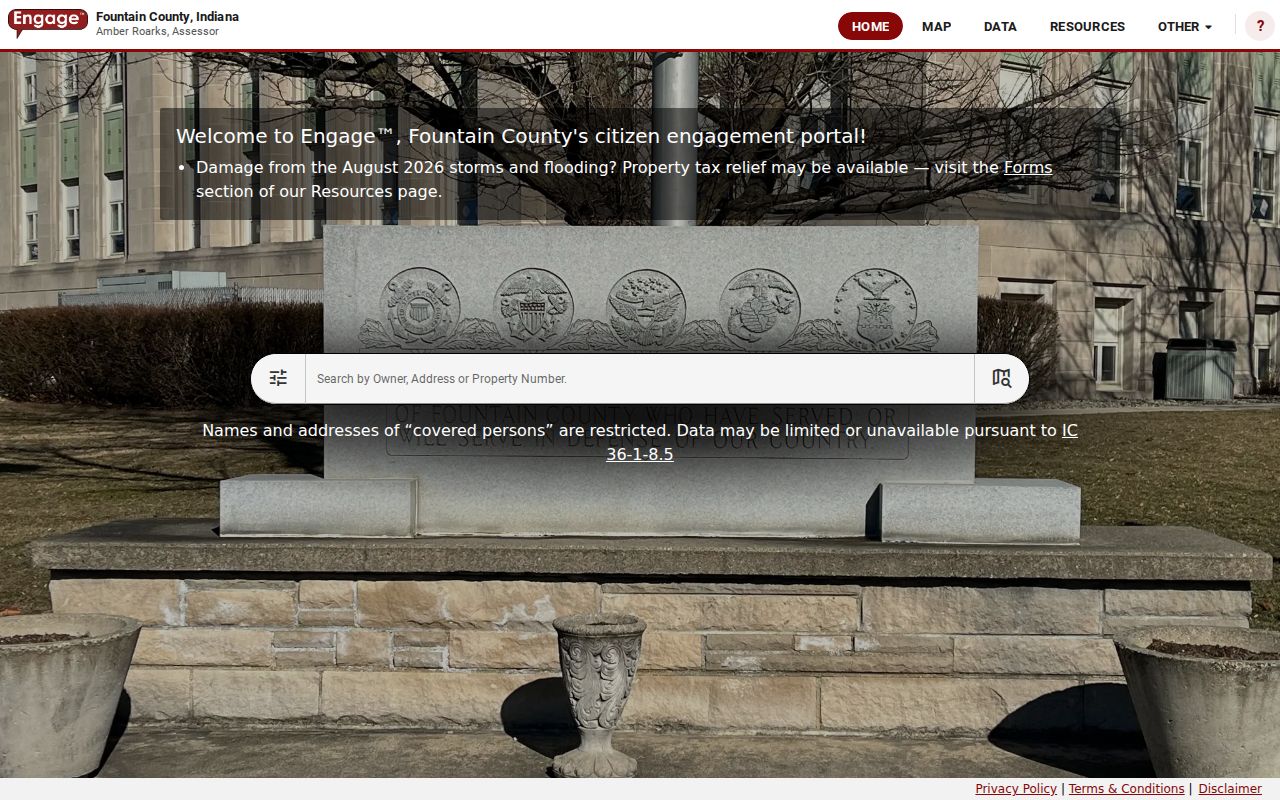
The map and data routes branch from the same starting clue.
Fountain Deeds Split Index and Image Dates
Doxpop indexes Recorder instruments from June 1992 and shows images from January 2003. Earlier deeds sit in bound books and on State Library microfilm, with runs reaching into the 1820s. A blank web result is never proof that a conveyance never happened.
Read the Deeded Owner as an Administrative Field
The parcel card calls the current roll name the Deeded Owner. It keeps mailing address separate from situs. Transfer History and Sales List offer clues. But a freshly recorded deed can reach the Recorder before the roll catches up. The county publishes no set refresh interval. Note your access date and verify any recent transfer against the deed itself.
Types of Fountain County Property Records
Different record families answer different questions and have different custodians.
| Record Type | What It Documents | Kept By | Access |
|---|---|---|---|
| Deeds | Recorded conveyances and parties | Recorder | Doxpop, counter, books |
| Mortgages and liens | Recorded encumbrances and releases | Recorder | Index and copies |
| Tax and assessment | Value, deductions, charges, payments | Assessor, Auditor, Treasurer | Engage and tax roll |
| Plats and parcels | Administrative geometry and descriptions | GIS and Recorder | Map viewer, plats, library |
| Permits and zoning | Local land-use approvals | Municipality or county | Office, forms, meeting files |
Choose the record that fits the question. Fountain County deed records cover conveyances, property tax records cover assessments and bills, and the parcel-map page handles spatial questions.
Fountain's Map Is a Multi-Tab Parcel Record
Open the Engage map result and you get a multi-tab parcel record. Tabs include Summary, Sketch, Transfer History, Sales List, Valuation List, Taxes, Land Info, Improvement Info, Neighborhood Amenities, Documents, Street View, and Forms. Summary identifies the parcel. Sketch gives orientation, and the valuation and tax tabs carry the administrative figures. The map number is its own field. It cannot stand in for the county APN.
A mapped line proves no boundary, easement width, monument, or title priority. Set the GIS map beside the recorded plat and the deed legal description. Bring in a licensed surveyor when geometry is disputed.
Property Tax Years and Installments Matter
Fountain County property records split the assessment year from the payable year. One sample shows tax year 2025 payable 2026. Current charges, spring and fall installments, and balance are each broken out. The Indiana Gateway tax lookup filters by pay year, county, district, taxpayer, parcel, rate, and bill. County-reported data can carry errors, though.
District changes the math. Pay-2026 totals differ across Attica district 008, Covington district 016, and Veedersburg district 018. Trust the district printed on the parcel record, not the postal city.
Fountain Courts Can Explain a Land Transfer
Indiana MyCase surfaces public foreclosure, quiet-title, partition, probate, judgment, and lien-enforcement cases. Search owners, lenders, trustees, or estates. Record the case number, filing date, parties, events, and disposition. Note any public orders too. For certified, older, or fuller local files, the Fountain County Clerk is the fallback.
A docket explains the litigation. It does not hold every paper. The Recorder still holds the deed, lien, release, or sheriff's deed that settled the case. Match names, dates, and legal descriptions instead of trusting either source alone.
Historic Fountain Land Books Reach the 1820s
The Indiana State Library inventory lists deed-volume and general-index runs, with GSU reel references, reaching back to Fountain County records from the 1820s. Its map collection holds an 1865 Fountain and Warren owner map and an 1897 Standard Map naming property owners, plus plats of Attica, Covington, and Veedersburg. Physical holdings are pulled through a call-slip process.
An old map can supply an earlier owner or plat label where modern addresses fail. Treat that name as an index clue. Then follow it into the recorded deed books, which remain the authority.
Property Watch Uses Names and Legal Descriptions
Doxpop Property Watch enrolls you free by state, county, and name or legal description. Indiana recorded instruments may omit an address or APN. Those fields cannot drive reliable alerts. Rural section-township-range descriptions can also trigger false positives across roughly one square mile.
An alert is a prompt, not proof of fraud. Pull the new instrument and check party names, legal description, recording date, and document type with the Recorder.
Liens and Releases Require More Than One Fountain Search
Start lien work at the Fountain County Recorder. Mortgages, assignments, releases, mechanic's liens, and easements all file there. Search both sides of the deal. The borrower or property owner appears on the original mortgage. The lender or claimant may carry the later release. A payoff alone never clears the search trail. Record the instrument number, recording date, legal description, and any book/page citation for every entry. The release or satisfaction is its own separate document.
Mechanic's liens follow their own pattern. The sworn statement lists the amount, the claimant's name and address, and the legal description. It also gives the owner's name with the latest tax address. The filing must land within 90 days after labor or materials. That window helps you locate a filing. An indexed lien, though, says nothing about whether it still binds the land. Pull the release, and for enforcement questions, search MyCase for the related court action.
For personal-property filings, Indiana INBiz offers a separate UCC Browse route for financing statements. Those results never replace Fountain County real-estate mortgage and deed records.
Probate Records Can Bridge a Fountain Deed Gap
An estate transfer may not resemble an ordinary sale. A personal representative, executor, trustee, or heir can appear in the assessor or deed trail, while the authority for the transfer sits in a probate file. Search the Fountain County Clerk and MyCase for the decedent, estate, representative, and likely heirs, then compare orders and dates with the Recorder's deed entry. A will or court order explains authority; the later deed documents the recorded land transfer.
For older work, the State Library Fountain County research guide points to wills, court records, marriage material, WPA indexes, original records, and libraries. The Covington-Veedersburg Public Library provides local-history and genealogy assistance, Ancestry access, copying, public computers, and interlibrary loan at its Covington and Veedersburg branches. These access channels matter when a name predates modern indexing.
Foreclosure and Tax-Sale Clues Live in Separate Records
A foreclosure trail cuts across several record sets. The Recorder index may hold a mortgage and lis pendens. MyCase may hold the complaint and judgment. The parcel card may show a later deeded-owner update following a sheriff's deed. Search the owner, lender, and trustee names. Then line up the filing, judgment, sale, confirmation, and recording dates in order. One filing alone does not make a property foreclosed. Label it only by the exact event and disposition the records show.
Tax-sale work starts with the Treasurer, where charges, balance, year, and installment status appear. It does not end there. Continue to the Auditor, the Recorder, and sometimes MyCase. One Fountain sample pairs a prior tax-deed note with a later split transaction. It shows that administrative history can mix tax and parcel events without proving current delinquency. The Treasurer publishes no official sale calendar, vendor, redemption instructions, or archived delinquency list online. Confirm those facts with the office directly.
Municipal Files Add Context to County Property Records
A foreclosure trail crosses several offices at once. The Recorder index may hold the mortgage and lis pendens, MyCase the complaint and judgment, and the parcel card a later deeded-owner update, with a sheriff's deed somewhere between. Search the owner, the lender, and the trustee. Then line up the filing, judgment, sale, confirmation, and recording dates. One filing alone does not make a property foreclosed. Use the exact event and disposition the records show.
Tax-sale research follows a similar split. Start with the Treasurer's charges, balance, year, and installment status, then move to the Auditor, the Recorder, and sometimes MyCase. One Fountain County sample pairs a prior tax-deed note with a later split transaction. That shows administrative history can blend tax and parcel events. It does not prove a current delinquency. The Treasurer publishes no online sale calendar, vendor, redemption instructions, or archived delinquency list, so confirm those facts with the office directly.
Indiana Access Rules Shape Fountain Record Requests
Indiana sets the rules for record requests statewide. The Indiana Access to Public Records Act, Indiana Code 5-14-3, gives any person a route to public agency records. A well-built request gets better results. Name the office and the record family. Include the parties, a parcel or legal description, and a reasonable span of time. The Public Access Counselor handbook walks through access rights, agency response duties, exemptions, and complaint options.
Open access still has limits. Sealed court material, restricted military discharges, and protected addresses answer to their own statutes. Other confidential fields do too. Indiana's Address Confidentiality Program supplies a substitute address for eligible participants. Under Indiana Code 36-1-8.5, a covered person may ask a county auditor to restrict a property address. A hidden address is a lawful restriction on the Fountain County property records. It is not a missing record.
Assessed Value, Sale Price, and Market Value-in-Use
Indiana assesses property at a 100 percent ratio. Assessed value is defined as a market-value-in-use estimate. That figure is not automatically the price paid in the last transfer. The Engage card separates land and improvement components, gross assessment, and cap category. It also covers valuation history and Sales List information. A processed sales disclosure can support comparison. XSoft cautions that older, exempt, or unprocessed sales may be missing.
For a fair comparison, gather the assessment year, payable year, land class, acreage, and improvements. Add district and any sale date. Use DLGF assessment guidance to understand market value-in-use. Check Fountain County ratio studies and land orders next for county-specific administration. A sale price reflects one transaction. Assessed value supports taxation. An appraisal answers a different valuation question.
The 2026 to 2030 cyclical reassessment schedule calls for one-quarter of parcels. Those parcels are reviewed each year. Annual trending and a physical review can move values on different timelines. Contest an assessment through the Form 11 notice and Form 130 route. Do not wait for the property-tax installment date.
Fountain-specific DLGF materials include ratio studies, approval letters, and land orders. When a parcel value changes, compare the applicable study year and neighborhood evidence. Also weigh land classification, improvement characteristics, and notice date. If a processed sale is missing, do not manufacture a price. Do not conclude that no transfer happened. Carry the owner and legal description to the Fountain County Recorder index. For tax consequences, weigh the assessment against deductions, credits, and cap category. Include district rate and the correct payable year. Each field belongs to a separate step in the calculation.
Address and Parcel Quirks in Fountain County
Fountain County splits a property's identity three ways. The situs address, the owner mailing address, and the legal description each answer a different question. A rural owner's mail may go elsewhere entirely. One card shows a legal description of 005-01817-01 FR PT E 1/2 NW 13-18-8 .034A while the lot field reads “Lots: See Legal Description.” Copy that shorthand exactly. Open the deed or plat first.
Splits and combines add friction. One parcel record carries an annexation, a combine, and a split area, plus a tax-deed note and mailing change, with a 2027 split transaction dated February 5, 2026. When a child APN appears, older numbers can look incomplete. Follow both identifiers through the card, the transfer rows, and the recorded instrument.
Postal place names only describe mailing geography. Attica 47918, Covington 47932, and Veedersburg 47987 tell you where mail goes, not who taxes or zones the parcel. District lines and incorporated boundaries rarely match ZIP lines. Fountain covers about 395.7 square miles, 11 townships, and roughly 41 miles of riverbank, so route and place-name ambiguity is a routine part of property research.
An address search can still fail. Try the surname alone first. Then test the full APN with punctuation, the separate map number, and LLC, trust, trustee, or estate variants. For historic Veedersburg land, also try “Veedersburgh,” the spelling used before December 13, 1893.
Limits of Fountain County Property Records
Public records answer the administrative questions. They show the owner of record, recorded instruments, assessments, bill status, and mapped parcel shapes. Clear title is another matter. Property records cannot reveal every unrecorded interest, fix a survey boundary, or replace a sale appraisal, and Indiana's Address Confidentiality Program plus IC 36-1-8.5 restrictions may keep covered names and addresses off display.
Lawful use. Use Fountain County property records for legitimate research, transaction diligence, boundary questions, and civic transparency. Do not use owner information to stalk, harass, or harm anyone.